
Kevin Warsh, the Fed, and What Central Texas Investors Should Really Expect Next
Interest rates. Inflation. The Fed. There’s a lot of noise right now around Kevin Warsh and the future of rate cuts—but smart investors know headlines aren’t a strategy. In this article, I break down the macroeconomic backdrop, what’s likely (not just hoped for), and how Central Texas real estate investors should position themselves over the next 12–24 months. If you’re investing along the I-35 corridor, this one’s worth the read.
MARKET INSIGHTS
Chris Parreira - Real Estate & Mortgage Advisor
2/6/20263 min read
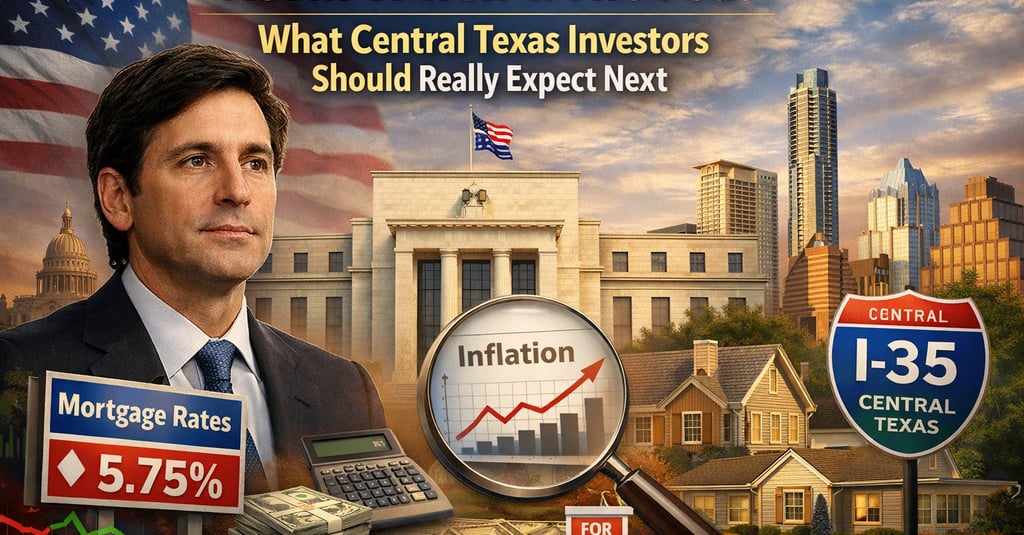
With headlines buzzing about Kevin Warsh emerging as the next Chair of the Federal Reserve, many investors are once again allowing themselves to imagine a return to ultra-low interest rates. The narrative is tempting: a Fed chair openly critical of high rates, a White House eager for cheaper borrowing, and a housing market that could use a spark.
But before investors in Central Texas start underwriting deals based on a sub-5% mortgage environment, it’s worth slowing down and separating signal from noise.
History (and the data) suggest caution.
Rate Cut Optimism vs. Economic Reality
Warsh has been vocal about his belief that interest rates can and should come down, particularly to restore housing affordability. That stance, combined with strong public support from Donald Trump, has fueled speculation that aggressive rate cuts could be on the horizon.
In reality, the Federal Reserve does not move quickly—or unilaterally.
Even if Warsh formally takes the helm this spring, meaningful policy shifts will be constrained by the same factors that guided his predecessor: inflation readings, labor market strength, financial stability, and the Fed’s institutional credibility. Despite the rhetoric, most forecasts still point to modest, incremental rate cuts, not a rapid return to pandemic-era borrowing costs.
For investors, especially those focused on cash flow, that distinction matters.
Inflation Still Sets the Guardrails
Despite cooling from its peak, inflation has not yet returned convincingly to the Fed’s long-term 2% target. That reality limits how far and how fast rates can fall without risking renewed price pressures.
Warsh may bring a slightly different tone to the Fed, but not a fundamentally different framework. Policy will remain data-driven, and large, sudden cuts would likely signal economic distress—not opportunity.
For Central Texas investors, this means underwriting should continue to assume higher-for-longer rates, even if gradual relief arrives over the next 12–24 months.
What This Means for Central Texas Real Estate
Markets like New Braunfels, San Marcos, Seguin, and the broader Hill Country remain structurally strong. Population growth, job creation along the I-35 corridor, and limited new supply, particularly in small multifamily, continue to support long-term fundamentals.
However, pricing power is no longer fueled by cheap debt. Instead, today’s environment rewards:
Conservative leverage
Realistic rent assumptions
Strong operational execution
If rates drift down slowly, as expected, Central Texas investors may actually benefit. Gradual easing improves debt service over time without triggering a sudden surge in buyer competition that pushes prices higher overnight.
That balance creates opportunity for disciplined investors who are willing to buy based on fundamentals rather than speculation.
Financing Strategy: Flexibility Over Forecasting
Trying to time rate cuts perfectly is a losing game. A more effective approach for investors right now includes:
Structuring loans with future refinances in mind
Considering shorter-term or hybrid financing where appropriate
Maintaining liquidity to capitalize on opportunities others can’t
Lending is likely to remain available, but underwriting standards will stay tight—particularly for smaller banks. Investors with clean financials, strong reserves, and local lender relationships will be best positioned.
Cash Still Has an Edge
In today’s market, cash (or cash-like structures) remains king.
Whether through equity repositioning, HELOCs, private capital, or partnerships, reducing reliance on high-leverage debt provides flexibility and downside protection. This is especially relevant in Central Texas, where well-located properties are still trading but buyers with strong balance sheets are winning the best opportunities.
If and when rates fall meaningfully, those positions can always be refinanced. Overpaying today in anticipation of tomorrow’s rates is far riskier.
Don’t Overlook the Operational Side
Regardless of where rates land, tenant retention and operational efficiency remain critical.
If borrowing costs ease into the mid-5% range over the next couple of years, some renters may begin exploring homeownership. Landlords who focus on service, responsiveness, and fair pricing will be better positioned to maintain occupancy and minimize turnover costs during that transition.
Final Takeaway for Investors
The excitement around Kevin Warsh and future rate cuts is understandable—but it’s not a strategy.
For Central Texas investors, the smarter play is planning for gradual change, not dramatic relief. Underwrite conservatively, stay liquid, focus on operational performance, and be ready to act when conditions improve—rather than waiting for a perfect moment that may never arrive.
There is no silver bullet. But there is an advantage for investors who stay grounded in reality while others chase headlines.
Contact
Reach out for personalized real estate advice.
Phone
© 2026. All rights reserved.